Asphalt Tank Coil Pack Cleaned to Bare Metal With Minimal Man-Hours
Eight inches of hardened asphalt removed from a 30,000 gallon shop tank in one 24 hour cycle. Nobody entered the tank while the fluid worked.
Most asphalt storage tanks are not cleaned because they are dirty. They are cleaned because an internal inspection is due or because of lost tank coil heat transfer efficiency.
Under the SPCC rule, facilities must assess the integrity of oil storage containers using the testing methods and intervals set by industry standards. For shop-fabricated tanks that is usually STI SP001, where internal inspection intervals run from five to twenty years depending on the tank’s corrosion protection. For large field-erected tanks it is API 653, where the interval is calculated from the tank’s own measured corrosion rate. Either way the tank must be emptied and cleaned before anyone can assess floor thickness and weld condition, whether that is a technician with ultrasonic equipment or a robotic crawler.
Therefore, the date may be known years in advance. What the tank operator controls is how the cleaning gets done, and how many people have to go inside to do it.
There is no single standard method. Depending on the site and the contractor, operators use some combination of:
Heat and manual removal. Turn the heaters on, cook the residue until it hardens, then chip and shovel it out by hand.
Diesel. Used as the cleaning solvent where the material is in suspension in the fuel and able to be disposed of as waste-to -energy.
High velocity water. Hydroblasting crews work the tank with water jets to loosen material into smaller pieces for easier removal.
All three share the same requirement. Confined space permits are required, people go inside the tank, and a vacuum truck is needed to extract the material. Using PolyClean Max LV will not eliminate these steps but significantly reduces them. PolyClean Max LV works without people in the tank. After removing the fluid, confined space entry is only needed for the vacuum truck to extract the now liquified heel.
A Midwest asphalt emulsion producer has a 30,000 gallon asphalt shop tank carrying roughly eight inches of hardened asphalt in the heel, with accumulated coke material on the heating coils, mixer paddles, float gauge and side walls. Without using the available circulation from the tank pumping system, agitation comes from the internal mixing paddles only. The coil pack is an unusual configuration with minimal distance between the coils allowing for less fluid access to the internal coil surfaces.
In December 2025 the plant took delivery of PolyClean Max LV, pumped it into the tank, and heated it to 250°F, agitating it with the tank’s existing mixing paddles. An initial inspection occurred after 8 hours. The fluid was pumped out of the tank through the plant piping network to an auxiliary tank to remove the manway cover for the inspection. The auxiliary tank had an 8-inch heel with a mound in the middle of the tank. After returning the fluid back to the original tank, over the following 16 hours the fluid was reheated and re-agitated, completing the 24-hour cleaning cycle.
No cleaning crew or specialist equipment entered the tank for the 24-hour period. Confined space entry occurred to enter the tank to remove the liquified heel and air-blow the coke residue resting on exposed areas of the coil pack. Vacuum extraction was used to empty both tanks, one with the coils and the auxiliary tank used for the 8-hour performance review.
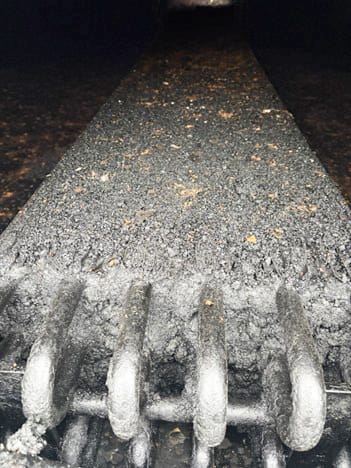
The 8 inches of heel of hardened asphalt on the tank floor emulsified into the fluid. After 8 hours, bare metal on the tank floor could be reached through the PolyClean Max LV.
The mixer paddles were clean to bare metal. The steel float gauge was clean as well as the tank sides up to the fluid line. The hardened asphalt and coke binders on the coil pack were dissolved into the fluid and most of the hardened coke material was in suspension in the fluid. The material remaining on top of the coils was easily removed during the vacuum extraction process using compressed air.
No one entered the tank while the fluid was working in it.
The plant fabricated a flat angle air nozzle on an extension handle and used plant air to blow the coil tops clean and bright. The consensus was that with proper circulation the top of coil pack would have less coke material fall out of suspension and settle on top.
Their assessment: neither the air nozzle nor scraping the coils would have worked before PolyClean Max LV was in the tank.
That is the practical value. PolyClean Max LV dissolved the hardened and semi-liquid asphalt cement and broke the bonds between the hardened coke and binders, allowing for easy extraction using the plant’s own equipment to finish the job.
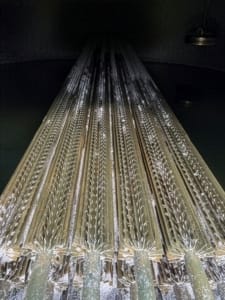
The asphalt tanker that delivered the PolyClean Max LV was not cleaned prior to the initial pick up of the fluid. After the fluid was offloaded into the initial tank, in the plant’s words, the tanker was as clean inside as when new.
After the 8-hour test period, the fluid was pumped while hot into the auxiliary tank. This tank had no coils to maintain heat, nor mixing paddles for agitation. This tank had an 8-inch heel of hardened asphalt, mounded in the middle of the tank. The warm fluid remained in the auxiliary tank for a few hours while entry was established to view the initial tank. The warm fluid dissolved the asphalt in this tank allowing for easy extraction of the liquid heel. This tank was clean enough after extracting the heel that the tank floor was able to be repaired.
It dissolves hardened asphalt. It does not dissolve coke. Coke remained on the coils after treatment due to settling out of suspension. The coke material was no longer bonded to the surface and compressed air easily removed it. Higher levels of turbulent flow than simple agitation allows the coke to stay suspended in the fluid rather than settling back onto the metal.
It cleans the surfaces it covers. Floors, heels, coils and low internals, which is where asphalt settles and where an integrity inspection is focused. Tanks needing full height cleaning are a different job but do not require additional fluid. For cleaning the walls and ceiling of the tank, contractors may use an extra piece of equipment to perform the job function of cleaning the walls; i.e. a manway cannon. PolyClean Max LV is in the tank performing the work, not personnel.
It needs heat. The trial ran at 250°F under agitation. Turbulent flow is better than simple agitation. Sites without heat and agitation should be evaluated before application. Flash point, viscosity and materials compatibility are on the TDS.
After the PolyClean Max LV cleans the tank, the dirty fluid is pumped onto a tanker for return to CHEM Group for distillation and not disposal. CHEM Group’s distillation process separates the PolyClean Max LV from the asphaltic residue, allowing only the residue to require disposal. The customer is only responsible for the disposal of this residue. The PolyClean Max LV is converted to feedstock and not waste, at no cost to the customer.
The value of PolyClean Max LV was not that it eliminated every final cleaning step. It changed the nature of the work. Hardened asphalt was liquefied, coke was released from the surfaces to which it had been bonded, and a difficult tank-cleaning job became a manageable extraction and final-cleanup process.
RELATED CONTENT
Explore how CHEM Group has helped other operators restore heat transfer systems, recover fluid, and cut downtime.
 https://chemgroupus.com/wp-content/uploads/2026/03/Heat-Transfer-Fluid-Regeneration.jpg
533
800
Dustin Vowels
https://chemgroupus.com/wp-content/uploads/2026/02/chem-group-logo-web-main-pad.png
Dustin Vowels2026-03-17 16:42:262026-10-19 16:02:45Ongoing Heat Transfer Fluid Regeneration Program Delivers 65–70% Cost Savings
 https://chemgroupus.com/wp-content/uploads/2026/03/monomer-leak.jpg
533
800
Dustin Vowels
https://chemgroupus.com/wp-content/uploads/2026/02/chem-group-logo-web-main-pad.png
Dustin Vowels2026-03-17 16:17:552026-10-19 15:34:08175,800 Lbs. of Monomer Removed from a Resin Plant’s Thermal Oil System
 https://chemgroupus.com/wp-content/uploads/2026/03/solar-farm-in-desert-field.jpg
533
800
Dustin Vowels
https://chemgroupus.com/wp-content/uploads/2026/02/chem-group-logo-web-main-pad.png
Dustin Vowels2026-03-04 11:36:212026-10-19 16:01:27Refurbishing 84,000 Gallons of HTF to Restore 64 MW Solar Farm Efficiency with Zero Downtime